Tag: technology

Using AI to Think Like a Harpist

As a clarinetist, I have spent much of my career interpreting music rather than arranging it. My instinct when adapting music from, say, a piano solo, to an ensemble piece (such as the Danzas Tristes Españolas by Víctor Carbajo, I’m currently revising for clarinet, cello, and harp) has previously been a matter of simply assigning notes from the original to the parts and hoping each player can work out exactly how it’s going to be played on their individual instrument. That’s how I’ve always done it, and it’s worked fine. Until now. Now, working with AI has changed that dynamic.

Just as letting AI write a story for me would take all the fun and creativity out of the process, I would never dream of letting AI transcribe the music for me. But, what I found was that by letting the AI act as a companion in the arranging process, it helped me understand better how to write idiomatically for harp and cello. Together, my AI friend and I went line by line through the score, finding ways to translate a dense piano texture into a clear, idiomatic trio for clarinet, cello, and harp.

For example, midway through the arranging process, I realised that the sound I wanted was more percussive than the piano score revealed. I wanted the music to have the flair of flamenco guitar. Just transcribing the notes and markings given in the original was just not going to be good enough. That’s when I turned to my little AI friend:

  • I wanted the harp to sound very dry, so I learned that adding étouffé would imitate the short, damped resonance of guitar strings.
  • I also verified that changing the beaming of chords would induce the harpist to alternate hands. For safe measure, I added “LH-RH” to drive home the idea.
  • To ensure an equally flamenco effect was given to the cello, I added sul tasto pizz. secco (quasi chitarra) for the cello to achieve a rounded, percussive tone closer to a mariachi guitarrón (rather than a sul ponticello effect, which is more brittle).
  • For the clarinet part, I re-beamed the melody to show its rhythmic vitality implied by the hemiola in the original.

Rather than taking creativity away, AI actually expanded it. It allowed me to access levels of creativity I would not normally afford myself, short of taking an orchestration course, that is. Instead, this process let me bring in exactly the tools I needed when I needed them, and my musical background gave me the instincts to know which tools to reach for.

Finding a New Voice for the Tárogató

Voice of the performer

My own journey as a musician has been through many migrations itself, and at times has all but gone extinct. Following my formal music education (University of Toronto, Banff Centre for the Arts, etc.), and a two-year stint with the Prince George Symphony, I became a regular extra freelancing with the Vancouver Symphony. After my near misses auditioning for the elusive orchestra job, I found that I’d basically sculpted myself into the sort of a player who might win an orchestral audition, but little else. In other words, I was left feeling more like a service provider than a performing artist. A long silence followed.

Voice of the tárogató

Then, following a fateful encounter with a certain tárogató, the flame was relit. When a Hungarian cellist-friend in Kelowna called to ask if I’d “learn his tárogató” to as to play it at the Okanagan Hungarian Centre, I didn’t expect to fall in love with the instrument so fast. I soon found a maker in Budapest to build me an instrument I could call my own.

In 2017 when I produced the concert Refuge, I sought to tell the story of the contribution made to Vancouver by the arrival of 200 Hungarian university student and faculty refugees following the failed 1956 Hungarian Revolution. Their contributions notably impacted BC forests practices and their presence is still felt today both at UBC and throughout the province. The concert drew large numbers from the Hungarian community as well as the general public interested in learning about this unusual BC refugee community.

“On behalf of the University of British Columbia, I am writing with warm congratulations on the completion and upcoming performance of Refuge. This legacy is something that UBC is very proud of and one that we cherish and celebrate.”
— Santa J Ono, President and Vice-Chancellor, UBC

Voice of the woodland caribou

There’s a larger community in British Columbia that I believe the tárogató can touch. A while back, I ran into composer Glenn Sutherland at a Vancouver Symphony concert and after various pleasantries, he described his work as a field biologist tasked with finding out why British Columbia’s woodland caribou were making their way onto the endangered species list. It’s so easy to feel helpless when confronted with such environmental catastrophes, but even so, I wondered what I (what we) could do to help let people know of this unfolding disaster.

Then I remembered a comment of Jeffrey Ryan’s at a rehearsal for the tárogató piece he’d written a couple of years before: “There’s something wild about the tárogató…” and I thought perhaps there was something we could do. As the idea of a composition developed, it became less a didactic message about the caribou, and more about giving a voice to the animal itself—as much as possible to tell the story from the perspective of the caribou. Thus was born the longer-range project, Caribou Crossing. But before that, I have decided that I need to develop and extend my own techniques on the tárogató itself, thus the short-range development project—Finding a New Voice for the Tárogató.

Finding that voice

The tárogató’s capabilities have been only lightly documented. When I went searching for a fingering chart, for example, I invariably found something appropriate to a novice player (one fingering per note).

My work on the tárogato showed much richer possibilities with  multiple fingerings that could be used both for colouristic effects and to facilitate difficult passages. Here’s an example from the tárogató I developed while learning Jeffrey Ryan’s challenging Arbutus for tárogató and piano.


How It Ends: A Post-Apocalyptic Schubertiade

Scientists speculate sometimes that an asteroid impact would be what it would take to throw us all back into the Stone Age. But no one ever imagined that the end of Modernity could actually turn out to be something much less dire.

In the end, it was a coronal mass ejection that took down our power grids—we lost all satellite communications, international travel, automated traffic systems, and Smart phones.

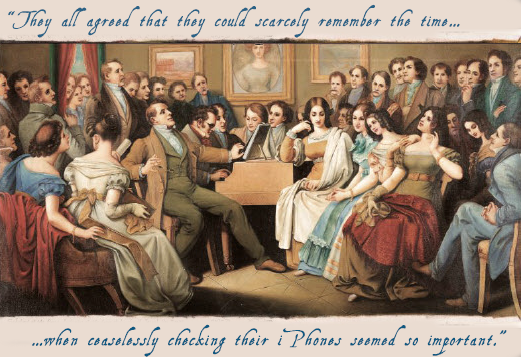
Lacking what we’d known as modernity, we could do nothing but gather with our friends about the piano…singing by candlelight.

So, it was not a bang, nor a whimper. Instead of the Stone Age, we’d been thrown into the Biedermeier.

Post-apocalyptic Schubertiade
“They all agreed that they could scarcely remember the time when ceaselessly checking their iPhones seemed so important.”