Focus on Technical Writing

Seminar: What’s the real job of a technical editor?

The Editors’ Association of Canada-BC presents

What’s the real job of a technical editor?

A One-day Seminar

Editors' Association of Canada

If the job of the technical editor is to make complex subjects accessible to normal people, why is it that so many technical documents fail. What is the real job of a technical editor?

Using real-life examples and humour, Jason will demonstrate just how spectacularly technical documents can fail and how you can become an advocate for excellent documentation. This hands-on workshop helps you assess your own skills while exploring what it is technical writers do. By the end of the workshop, you’ll have developed your own toolbox of skills that technical writers need to succeed.

When: Saturday, November 27, 10 AM- 4 PM

Where: SFU Harbour Centre, room TBD
515 W. Hastings St., Vancouver, BC

Instructor: Jason Hall

Cost:

  • Early Bird (on or before Friday, Nov. 12, 2010) Member: $100.00  Non-member: $160.00
  • After Nov 12: Member: $100.00  Non-member: $160.00
  • Note: Registration closes Friday, November 19 at 5 Pm

Register

About Jason Hall

Jason Hall has over 15 years of technical writing and training experience and brings excellence to all his documentation endeavours. He has prepared industry-relevant user manuals and training materials for a great variety of industries from law enforcement to inventory management to health care software products. Past clients include SAP, Best Buy, WorkSafeBC and Health Canada. Jason is comfortable with the full documentation development cycle including interviewing subject matter experts, creating documentation needs analyses, and converting product specs into accessible end-use documentation.

Writing for the Web: Clarity 7/7

Use Standard English

Replace the non-standard English words with their English equivalents. Word constructs like ‘and/or’ and ‘he/she’ are technically not words, so you should avoid them as much as possible. This is a good approach, because it’s easy to rely too much on them even when there is really not logical need. Take for example, “You can call and/or write to request a free estimate”. There’s no real need to say ‘and/or’ in such a situation.

How would you rewrite the following to remove and replace non English words?

  • Our global portfolio (accessed via our web site) invests in U.S. and/or foreign markets (i.e., commodities).

Writing for the Web: Clarity 5/7

Avoid Ambiguous Pronouns

The best way to avoid this kind of confusion (what kind of confusion? The confusion that results from ambiguous pronouns), is to read your copy carefully checking that you can easily identify the noun that belongs to the pronoun. If more than one noun emerges as a possibility, replace the pronoun with its intended noun.

What’s rolling toward second base?

  • The ball
  • The wall
  • Winfield’s head

Latest image – September

I’m resolved to knowing everything there is to know about transparencies and gradients. Here’s the latest mandala—for the month of September.

July is about change

I’ve been speaking with a lot of people recently who’ve expressed how much change they’re going through these days. Maybe it’s the economy or the realization that the environmental chickens have finally come home to roost, but it does indeed seem like change is in the air.
For my 2010 Mandala a month, I’ve called July’s entry “Change”. Although a mandala is fairly static, the fascination I have with mandala’s is how they focus my mind. It’s like watching a fire. It’s mesmerizing.
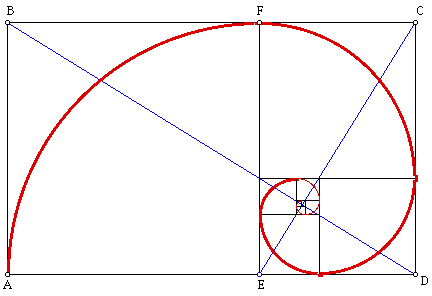
By way of explanation, this mandala is based on the golden mean – that is, the number 1.61803399. There have been a lot of studies done into design in nature as well as asthetics that indicate this number prevails. For example the nautilus is based on it.

This isn’t a scholarly document, so I’m not going to go into details about how the golden mean (ratio) comes into play here, except that it does.

My first draft of turning this into a mandal was promising, but not really up to standard (my measurements were off for one thing).

The problem was that I couldn’t figure out how the circle came out of the square, so I decided to jetison the squares and look at circles instead. The core concept, still fitting with the nautilus (golden mean) ratio and placement resulted in the following:

I then replicated it four times, recoloured it, used that set angle at 45?, played with opacity, shading and voíla!

July - Change

Roman Antics

This is such a clever way of visualizing data creatively that I had to share it.

New Photoshop Skills

An intended consequence of taking the Kelby Photoshop seminar last week at the Vancouver Trade and Convention Centre was to pick up new skills. And learn new skills I have!

To the right is an example of my new skills with creating realistic reflections and luminosity in an object. Also, I’ve started using my WACOM pen with different brushes to create artistic layered effects.

In the space of three hours, I popped out four flashy images on this theme.

May Mandala

I just finished my May mandala. In 2010, I completed one mandala image a month for 12 months as a way to improve my Adobe Illustrator skills and just for sheer diversion. May’s mandala is based on the himalayan poppy, also known as Meconopsis betonicifolia. There’s a sky-blue simplicity about these poppies that I find inspiring.

See all my Mandalas in (one per month for 2010).

Style and Tone

Discussing Style and Tone in technical documentation in the technical writing field is usually a one-minute conversation that really doesn’t even address core issues. Usually, the conversation is about style guides or templates (which has nothing to do with style) and tone hardly even enters into it.

Here are some quick definitions:

Style

Style is the cumulative effect of choices about words, their forms, and their arrangement in sentences. Style is not just a decoration but rather is a atter of substance. Style affects comprehesnion and a reader’s attitude toward the document.

Tone

Tone is the writer’s attitude toward the reader as well as the subject matter. It describes the writer’s relationship to the reader—colleague to colleague or teacher to student. Tone also describes one’s own persona. Persona is the mask you wear as a writer. Do you see yourself as an authority on a given subject or an explorer sharing your findings. That’s tone.

Planning and Ergonomics

In a collaborative environment with multiple teams, communication is critical. To illustrate this point, a picture is worth a thousand words, no?