Nu:BC Collective unmasks madness fit for a king

The following is a review written for publication in The Vancouver Observer.

Masque-19-VO


“I’M NERVOUS!!!!! If you want to know what is the matter with me I AM NERVOUS!!!”, quoted tenor Will George on his Facebook profile just hours before his title role performance in Eight Songs for a Mad King. Will was justifiably nervous: Eight Songs, based on the real-life madness of King George III, is a tour-de-force treatise of modern vocal techniques­ spanning a mighty range of over four octaves.

It’s not just for the madness I’d come. (Sir) Peter Maxwell Davies’s Eight Songs ranks, along with Schönberg’s Pierrot Lunaire and Stravinsky’s The Rite of Spring,among the top twentieth-century works of contemporary concert music.

“Who has stolen my key?”

Sadly for UBC-based hosting ensemble Nu:BC Collective (flutist, Paolo Bortolussi; cellist, Eric Wilson; and pianist, Corey Hamm), the first part of the programme was arguably more maddening than the featured work. Like falling dominos, each of the electronic pieces fizzled making nervous geeks out of respectable UBC composers Bob Pritchard and Keith Hamel. While they strained over their laptops, the audience stared expectantly forward at idled musicians who for their part stood helplessly clutching perfectly functioning acoustic instruments. Finally, pianist Corey Hamm rescued the moment with a little Bach-Gounod arpeggiation and the audience filed out for an extra intermission.

“Blue-yellow-green is the world like a chained man’s bruise.”

On our return, the stage was set for the entrance of the king even though Diane Park’s inventive set design, a triumph of economy, looked as if she’d done it on a budget of no more than $75. I have no idea the actual cost but after the performance, Diane said how much she’d enjoyed the challenge of designing Eight Songs  because of how it sits in the nearly uncharted waters between chamber music (“No sets required if you please”) and music theatre (“My dad’s got a barn—let’s put on a show!”).

8Songs-cages


The trick in all this is making musicians—who in a strict sense can’t act—be part of the action. To accomplish this, Diane enclosed each of the four front musicians in bird cages and dressed up their formal concert attire with brightly coloured neck scarves and feathers making them look vaguely like late eighteenth century birdmen. There, they could go about their music-making business while doubling for theatrical purposes as sets.

The remainder of Diane’s budget was reserved for Will’s regal purple robe (with genuine thrift store ermine) and of course that extra violin that would later become pivotal to the action. At key junctures in the performance, Will disrobed revealing a little more of the history of the period—most effective was his recoiling horror on discovering the lining of his robe was sewn in with an anti-royalist American flag.

8Songs-costume-fitting

“Sometimes he howled like a dog.”

Singers, unlike musicians, are expected to be able to act and sing and all the rest. For this performance, singer Will George was at his best. After the performance, Will described his preparation for the role: “When I started preparing the piece, I wasn’t sure how I was going to produce all the sounds and extended techniques required. As I started listening to modern recordings and watching YouTube videos, I noticed that almost none of the performers were attempting these techniques, much less the pitches. This took a little pressure off, but I did want to be as faithful to the score as possible.”

Masque 16

During the performance, Will took some opportunity to interact with the audience and particularly with the musicians, but otherwise his actions all seemed to precipitate from his inner mental anguish. Perhaps the blocking was a little jerky but I hardly noticed for the fact that Maxwell Davies’s music is so endlessly interesting. From the opening chords, which disassembled from rhythmic unison into chaos to Corey Hamm’s rapid transitions from harpsichord to piano to play a few baroque flourishes here followed an instant later—and several decades musicological speaking—with corresponding flourishes in Mozartian classical style there. Even when referencing earlier composers, his music never sounded referential. Indeed, it provided us with the context needed to appreciate the unfolding drama.

“Poor fellow, he went mad.”

There’s a long tradition of on-stage musical instrument destruction but they’ve occurred mostly in rock and jazz circles, not so much on the classical concert stage. In fact, Eight Songs may be the only such work. Most audience members last Thursday would likely have known of this scene, so as Will George snatched Mark Ferris’s violin and then smashed it to pieces on the stage right there in front of us, there was an air of quiet that seemed downright pornographic. This sort of behaviour is to chamber music what CGI is to the movies—both for titillation and expense.

Sadly, there was only one performance of Eight Songs but, hey, if you’ve got an old violin you’d like to sacrifice, Nu:BC and company might be willing to mount it again.

Smash-violin

Masque

Nu:BC Collective’s performance of Eight Songs for a Mad King is part of a series of new music concert continuing throughout April. I can’t say for sure if any violins will meet their end, but the line up is otherwise very promising.

Upcoming in the Masque series:

  • Apr 17 & 19 – Turning Point Ensemble – featuring works by Benjamin Britten, jazz artist Tony Wilson, Bradshaw Pack, and arrangements of medieval and renaissance music by Peter Maxwell Davies and Harrison Birtwistle.
  • Apr 24 & 25 – musica intima – featuring music befitting a Venetian Carnival – masks, theatrics, and salon-style seating, and vocal works by Adriano Banchieri, Orazio Vecchi, Giovani Gabrieli and Claudio Monteverdi.

Vancouver Chamber Choir explores spring’s veiled splendours

The following is a review I wrote for The Vancouver Observer.


Vancouver Chamber Choir - Orpheum, 2015

When it comes to springtime, redemption is a less marketable commodity than, say, bunnies and chocolate eggs, so on a blossom-filled Good Friday, I was surprised to see that the promise of crucifixion, mortal sacrifice, and death was enough to pack the Orpheum with an audience enthusiastic to try a bout of the Vancouver Chamber Choir’s darker fare.

After the opening work, VCC Conductor Jon Washburn revealed his enthusiasm, “Isn’t it a gem?” he said. The gem, Heinrich Schütz’s Die sieben Worte Jesu Christi am Kreuz (The Seven [Last] Words of Christ) was indeed a gem—hidden in a jewel box, shrouded in velvet, and encased in solid seventeenth century solid German cabinetry. I revelled how, with clockwork precision, it unveiled its beauty layer by layer.

Vancouver Chamber Choir

Photo courtesy Vancouver Chamber Choir

Next up was Schütz’s Italian contemporary, Giacomo Carissimi, who took us back much further to the early days of the Old Testament. Maestro Washburn told us the tale concerning the tragedy of Jephthah, an Israelite general who made a vow that if God would deliver them from their enemy, the Ammonites, Jephthah would offer up the first who greeted him on his return as “a burnt offering”. Tragically, that turned out to be his beloved daughter, Filia. Carman J. Price, tenor, sang Jephte and Catherine Laub, soprano, captured Filia’s fall from girlish innocence to condemned outcast in a way that to me felt as contemporary and horrific as anything on the evening news. Although her role was relatively small, Fabiana Katz, alto (historicus) also picked up on the horror in a way that made my ears snap to attention.

Even though the Requiem is sung in Latin (duh, it’s a requiem), there is something so innately French and nineteenth century about Fauré’s treatment of it. Fauré’s Requiem seems synonymous with Gustave Caillebotte’s Rue de Paris par temps de pluie, the way it portrays everyday life (and death) as a gentle thing.

"Gustave Caillebotte - Paris Street; Rainy Day - Google Art Project" by Gustave

Photo courtesy Wikipedia/Chicago Museum of Art

Fauré is masterful in his reduced orchestra, replacing violins with the throatier violas, decimating the woodwind section but for a couple of bassoons, and retaining only an echo of brass (2 horns, 2 trumpets) enough for one or two volleys, but more in the sense of Haydn and Mozart than the resources his contemporaries had at their disposal.

While the performance was fine and reverent and all, it didn’t really congeal until soprano Siri Oleson captured our attention with Fauré’s indescribably gentle Pie Jesu. With that, I think many audience members succumbed to very personal reflections and, in some cases, even tears.

For the Fauré, the Vancouver Chamber Choir was joined by the Pacifica Singers and the Vancouver Youth Choirand their inclusion added much to an already full programme. Now we see all the faces of Vancouver— many cultures young and old come together­—singing.

If you missed this concert, springtime is full of singing:

  • 24 April, the Vancouver Chamber Choir presents Youth & Music 2015 – New Choral Creators at Ryerson United Church in Kerrisdale
  • 1 May to May 3, The Vancouver Youth Choir participates in Canadian Cantando Music Festival up at Whistler.
  • Also, for those of you whose interest in choral music goes beyond mere listening, the Vancouver Chamber Choir is holding auditions for professional-level singers on April 25 and May 23. Contact Grant for an appointment at grantwutzke@live.com

“11” Questions for Ghosts of Wars Past

Like Paula Jardine’s A Night of All Souls, Mark Haney’s “11’ for brass ensemble, about the Renfrew Heights Veterans Housing Project, brings people together in open dialogue about death and through it a renewed respect for the courage of life.

It was a dark and stormy night…

Remember, remember

It was a dark and stormy night…but that wasn’t enough to stop Mark Haney’s brass players from strapping on their rain gear and heading into Mountain View Cemetery for this year’s A Night of All Souls ceremony.

Mark was following a thread similar to Paula Jardine (creator of A Night of All Souls), which is to bring people together in open respect and dialogue about death and the dead. And with this being the centenary of the First World War, Mark Haney’s “11” is also helping to shed light onto a Vancouver neighbourhood touched by war—and maybe even heal some ancient wounds.

11 Questions

When I asked Mark, a professional double bass player by trade, how he came to be writing music in a field so far removed from his occupation, he started by describing his years as a commercial musician “just gigging and trying to make a living”. He alluded to a few professional disappointments that prompted him to question his core purpose as a musician. He concluded that what he needed to do the kind of projects that he loves—the ones that fascinate him most—even if the money wasn’t there. Then one night in 2000 at the bar at the Banff Centre for the Arts, the famed double bassist Edgar Meyer bottom lined it for him: “If you wanna write, you gotta play; if you wanna play, you gotta write”. Mark knew he had to start creating his own music.

Mark Haney shields a fellow musician from the elements at last Saturday’s A Night of All Souls. 
Photo courtesy Tim Matheson

Two years ago, Mark approached the Parks Board for an artist studio residency at the former caretaker’s suite in East Vancouver’s Falaise Park. The field house stands not far from the Renfrew Heights Veterans Housing Project, a neighbourhood with a unique history that would become his focus for writing and telling important community stories.

Among the many materials Mark Haney and fellow researcher Diane Park uncovered at the National Archives was this one featuring wartime musicians, including Mark’s Doppelgänger on double bass, flanked by tubas.
Photo courtesy Library and Archives Canada.

The Greatest Generation

As Mark began his research, he was shocked to discover how much he didn’t know about the Second World War. “It’s not like the Hollywood war films at all”, he said, “There were no tours of duty­—most men were in the war for four or five years.” He described the scene of D-Day in which they “turned people into cannonballs” driving them up onto the beaches of Normandy even as their comrades around them were mowed down. In preparation, soldiers trained for months on the beaches of England to “head inland no matter what.” “You can’t fail”, was the drill and “You don’t help anyone. Period. Get inland.”

Edge of darkness

After the war, many veterans returned to Vancouver suffering from what today would be diagnosed as Post Traumatic Stress Disorder. They bought homes in the Renfrew Heights Veterans Housing Project, but with no support other than similarly traumatised veterans, problems began. “It was a tough neighbourhood”, said Mark describing the problems, which included physical abuse and alcohol, as the veterans tried to lead normal lives. But, feeling more and more isolated from mainstream society, the veterans retreated into their homes and the local Legion Hall. Many of their children bear the scars of a war fought before they were born.

Aerial photo of Falaise Park and the Renfrew Heights Veterans Housing Project during construction.
Photo courtesy Library and Archives Canada

Mark realised that the stories of these veterans and their families needed to be told. “It’s a living history we’re about to lose”, speaking of the veterans but also the Project kids, now in their 60’s. But to tell their stories, he first had to earn their trust.

What is your name?

As a gigging musician Mark knew how to put on a show, but the last thing the veterans needed was a showman. The veterans had had a lifetime of training at being shut down, so their first inclination was to close ranks. “What’s your agenda?”, they’d ask, “Who are you?” and “What do you want?”, they’d demand.

Marketed to veteran’s as a “working man’s Shaughnessy” the houses were actually tiny. Construction of the Renfrew Heights Veteran’s Housing Project in 1948.
Photo courtesy Library and Archive of Canada

Who among you lived in the Project?

As a tough community that’s been together for years, there’s a lot of pride too, but Mark added, “Along with the pride and the community, there’s an edge of sadness—always”. He’d have to prove through his music that he was interested in them as individuals, and that his project wasn’t a flash in the pan—he would see it through to completion. “My piece is about eleven individuals in the war”, said Mark, “I composed it to put a human face on the wars.”

Laura Williams was part of the Women’s Division of the RCAF.  After the war, she and her husband Frank Helden moved into the Project. Their daughter Betty Helden became a big supporter of “11”.  Photo courtesy Betty Helden

Even so, he learned that some veterans couldn’t go to Remembrance Day events. “They’d stay home and cry”, he said. Often they’d go to the Legion and drink, but it was more wallowing than release from the pain, “All they did was re-live the war”.

Not all the veterans represented in “11” have passed away. Diane Park, a videographer who’s working with Mark on “11” mentioned 99-year-old Edmond Champoux. “He’s very much alive and a big supporter of ‘11’. He has shared stories with us of surviving the horrors of D-Day (as an Engineer he was one of the first on the beaches at Dieppe), as well as the Battle of Falaise Gap”, she said adding, “He lived in Renfrew Heights from the early 1950’s until moving to Burnaby two years ago.”

Edmond Champoux during the war. Photo courtesy Edmond Champoux

When were you born?

Mark found ways to help make people feel comfortable and open up. Last summer, he put up a display about their story at his field house. “It was very touching”, he said, “I learned so much in so many ways, by communicating and working with people who grew up in the Project.” Gradually, people began warming up to him. They still needed somebody to talk to, and as they began to open up to him, the stories increased.

At A Night of All Souls on Saturday, Attendees could come in from the rain for tea and gingersnaps and view the display created as part of the “11” project.
Photo courtesy Tim Matheson

To put humanity into the story, Mark developed a system of numbering in which each of the 11 brass instruments would spell out the name of an individual veteran (using only the letters from the veteran’s name that corresponded with musical notes). At Mountain View on Saturday night, some of the players actually played at the gravesite of the deceased veteran whose name they represented.

When did you die?

Although Mark scored “11” for brass instruments, he was sensitive to avoid any direct military references. In the drizzle on Saturday night, the brass players sounded sombre and perhaps a little amphibious too as they called out to each other from around the cemetery. “The last section I wrote follows the solo trumpet asking ‘When did you die?’” Mark said, “As each of the 11 musicians said their date, it was more like writing dialogue than music.” Huddled under umbrellas around the smouldering Swedish torch (a burning log set on end), we listened to waves of brass polyphony waft through the cemetery and occasionally letter/notes would well up in great wet chords.

On Saturday night at Mountain View Cemetery participants volunteered to hold umbrellas for the beleaguered musicians making it a truly immersive experience.
Photo courtesy Tim Matheson

Falaise Park

Mark’s been getting reports of friends and relatives of the veterans who are planning trips (from as far away as Edmonton, Calgary, and Nelson) to attend this special Remembrance Day concert in Falaise Park. He hopes for perhaps less rain than at Mountain View, but then laughs, “We now know we can do it in the rain if we have to”.

Together with Diane and the 11 musicians, they plan to accommodate all sorts of groups by providing wheelchair accessibility, an opportunity for nearby school children to sing a new song-version of “Flanders’ Fields”, and Linda Jones, a veterans’ entertainer (and Project alumnus) will sing once again. Afterward, everyone will gather in the gym at nearby Vancouver Christian School for coffee and snacks, where the display materials will put a human face on courage in the face of war and tragedy.

Simplicity

Les Très Riches Heures du Duc du Berry

I spent the month of July this year in Paris. In summer, Paris is very exciting with the Fête de la Bastille parade, the Bal des Pompiers, the Tour de France, and many other festivals all happening simultaneously. The city crackles with excitement. Yet with two thousand years of history, what is a little missing in the summer sun are Paris’s subtler sides.

I have a deep love for the quietude and timelessness of Medieval thought. I’ve always admired the multi-panel manuscript Les Très Riches Heures du Duc du Berry for its depiction of simple life…and that blue, blue sky that seems to bear witness to a timelessness now so rare. Part of the book depicts everyday life throughout the year (it’s a book of hours afterall). What I never knew was that in the October panel, the castle is a real one and that it still exists—in part. It is the original Louvre.

Over the centuries this old castle, with its many ardoise turrets, was gradually erased and replaced by successive regimes bent on modernizing it and putting their stamp on it. But in 1989 when excavations were made to build the Carrousel du Louvre (the pyramid), the original Louvre was rediscovered.

One bright and hot day, I followed the self-guided tour that takes you down to the foundations and origins of the Louvre. On the walking tour, you can now walk through the original moat and the substructure of the walls and donjon (keep). There’s nothing much else remaining, just simple stonework, yet my eyes set these stones high against that azure Medieval sky. And stared.

Upstairs, the Mona Lisa, the Venus de Milo, and a thousand other art treasures awaited, and yet I stood mesmerized by these unadorned stones. It’s not what you’re looking at so much as what it evokes.

The galley slave, the orchestra conductor, and the kitchen party

There’s a kitchen party going on in my head these days. It could be the air here in the south of France where I’m otherwise churning out corporate blogging content for Vancouver clients, or it could be that I’m discovering that the kitchen party in my head is pretty effective for getting certain things done, I don’t know.

Recently, I read a story, which utilized the popular metaphor of the orchestra conductor to describe enlightened leadership in a corporate setting. I liked the comparison, but I had to look elsewhere for a metaphor that was more enlightened still.

How do Slave Galleys Work?

Credit: funnytimes.com

In the old, OLD days, employees were seen merely as resources (sometimes costly ones). Like a slave galley, most everyone was chained to his post and the “employer” used negative motivation (usually whips and torture) to produce results (i.e., forward movement).

Why is an Orchestra Conductor more Enlightened?

The orchestra conductor metaphor is considered more enlightened, because everyone brings together his or her best talents under the conductor’s light touch, (who of course brings it all together into beautiful music). The emphasis is on bringing out each person’s unique talents.

Dumas – “The orchestra when tragedy is being played”

Having played in a symphony orchestra, I know firsthand that it is not always that enlightened. An orchestra is extremely hierarchical, music is programmed sometimes years in advance, and except for first-chair players, there’s very little freedom to interpret the music freely. Bluntly: Sometimes it’s much, much closer to a slave galley than what you might imagine.

So, Why a Kitchen Party?

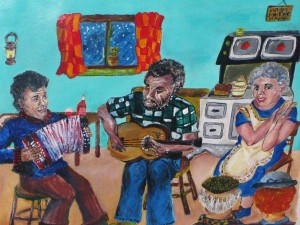
In a kitchen party, everyone is draw there because he or she wants to be there. There is no obligation—it’s a party! Everyone participates and everybody shares equally in the creation. There may be a host, but no leader. If you don’t want to play, you can always sit out (or leave). Kitchen parties seldom have distinct rules and, being spontaneous, they tend to follow rules set out by those involved. It’s a viral happening.

Newfoundland_Kitchen_Party_by_AlexisLynch
Credit: Alexis Lynch

I believe that if everyone who disliked his or her job were to quit, after the initial bumps and burps as the world reconfigured itself into one in which people only did what they were drawn to do, things would probably improve considerably. This is the kitchen-party metaphor: Love what you do or do something else.