Hey Bird! You’re Beautiful

HeyBrid

As many animals cannot recognise themselves in a mirror, it’s extremely helpful to them if you tell them how great they look. Don’t just walk by and say nothing.


Say something reassuring like…

“Hey bird, you’re beautiful!”,

or…

“Way to go Mr. Rat. I like the look. Very edgy, very edgy.”


This is tremendously helpful to their self esteem and you’ll probably feel good just saying it too.

rats3.0

Listening to Mark Dresser

MarkDresser-listens

What does it take to let go of the past and embrace pure potential? Billions are shuffling about — fearing. Fearing! Clearing the mind takes courage. It takes fortitude.

Not long ago at the Western Front, I heard a great musician—Mark Dresser. I could tell he knew implicitly that we weren’t there for the notes—so he didn’t play any—he was concerned with following the Muse.
The Muse always seems a little sad when I encounter him. Sometimes I think it’s my influence—on account of his devotion to the present—that causes his sadness. The Muse has difficulty understanding the human obsession with planning and the constant need to gather up our past possessions. To him, we must seem like idiotic squirrels—burying, then searching.

But Mark Dresser’s contrabass would not sadden the Muse as others do. Why? First, Mark listens—he waits until he can hear the whispers—and then he goes. He clearly has years of experience and technique to draw on, but he didn’t drag any of that out on stage like a bag of old chestnuts. When Mark played, I sensed how my mind would work were it freed of its feverish thinking. As I followed Mark, instead of the usual memory-anxiety machine, my mind became a finely tuned astrolabe constantly adjusting for those moments of inspiration.

Mark’s playing is instructional too. It provides a working example of how to think creatively and spontaneously. Mark follows phrases of his own making only so far as they’re fresh and then, whenever their trajectory hints at turning into stock patterns or set clichés, he abandons them in favour of another direction. I learned (again) that this is how creation works. Let go of cleverness. Let planning go. Defer your inevitable fame and trust that the next impulse is the right one.

But how quickly we’re drawn out of that shaft of light and descend into our infernal calculations. For me they go something like, “Will they like it?”, “Will they like me?”, “I must prove I’m not a fraud.”, “I’ll show them!” So you see, the Muse is frequently sad. He sees all that distraction right away and in that, little hope for anything new or authentic.
Lucky for us though, the Muse is ever hopeful of an opening—he’s the ultimate optimist. Even in the most formulaic calculating turgid undertaking, he’s there, waiting to be called upon. Who knows? With our human knack for calamity, something could go wrong forcing a desperate act of improvisation—and that’s his opening.

We all know our endless planning is little more than a buttressed attempt to avoid that opening. That’s why a sincere artist knows to let go of his craft. First, he knows he doesn’t have anything to prove (something yet to be learned by the unseasoned artist), but more, he learns that the tools (of his craft) are but a means to the end.
I found Mark Dresser a great player because he listens deeper than mere impact. He’s listening to the Muse’s whispers and making visible (or in his case, audible) those whispers for us. With Mark, we can witness the Muse at work and, of course, that’s ultimately why art matters.

—Jason Hall

Laughter. How did all that get started?

LaughingHands-sm

There’s much talk about the theory of how fire was harnessed,
And of the wheel, of who got killed first, and of Caan and Abel.
But what about laughter? How did all that get started?

Did something rise up out of the depths of endless time,
Having within it, already formed,
The seed of humour?
Like it was tickled into existence.

From what pool of primordial mirth did laughter emerge?
The eye was a blob that evolved to see, of course,
But when did it first twinkle with inner merriment?

Was the first laugh a howl or just a little chuckle, like a spark.
Did the first spark emit a giggle or a chortle?
Then, over millennia, did the little smirks and titters grow and spread.
Until they blazed into guffaws and cackles?

In the time of stones, what foolery ridded men of their ancient hours?
Long before the first civilization arose and fell,
What little tribe of wanderers collapsed
Into gales of laughter?
Before there was slave and master,
What hilarity first captured the people?
Until tears streamed down their rough-hewed cheeks
(now chiseled also with laugh lines).

Who first slapped a knee?
Who was the first joker?
The first clown?
The first wise guy?
Who first discovered the punchline?
Who first laughed at a fart or a funeral?
Who’s belly first ached from laughing?

And when were we first given over entirely to this great mirth?
Like we were tickled into existence.

Sigh.

You had me at gravitas — two concerts

St.-Andrews-Wesley-Church

Every Wednesday, three musicians hold a little performance of improvised music inside the cavernous St. Andrew’s Wesley United on Burrard. I went because I’m curious to hear Classically trained musicians who are willing to improvise. The constriction of their music training is such that, when improvising, many highly skilled Classical musicians can do little more than eke out a few trills.

These three musician could clearly do more than eke out trills — despite their Classical training — particularly the pianist Craig Addy who had the capacity to create vast landscapes of sound enough to fill the church and parts of Burrard street as well. Unfortunately for the three, they’re trapped in a new constriction even more asphyxiating to improvisation than Classical music — New Age music.

I listened patiently waiting for something to happen. My mistake. The entire point of New Age music is that nothing should ever happen, and to that degree it was a success. Here’s the core problem. New Age music is already “there”. There’s no getting “there” because it’s already “there”. So it has nowhere to go. New Age Music merely sits in its self-satisfied beauty doing nothing. Occasionally, it’ll glance about and change from a state of serene beauty to beautiful serenity, but that’s about all it can do. It’s a downright infuriating experience if your life contains other hues, which is the case for most people still claiming a pulse. Or in Dorothy Parker’s words, “a striking performance that ran the gamut of emotions, from A to B”.

PuSh2016_Limmediat2_credit-Cyrille-Cauvet-675x449

The other performance, L’Immédiat (part of the PUSH Festival), was something of a circus. There are really no words to compare the two performances, except that I have a few extras so I’m going to try anyway.

L’Immédiat plays in the diametrically opposite court to Craig Addy’s group. Instead of well-worn clichés of peace and serenity, L’Immédiat plays with chaos and to a certain extent tragedy — although not in a way you’d recognize it as such because it’s so absurdly funny.

Mostly, L’immédiat is about gravity. Not the concept of gravity, but the reality of gravity. Spoiler alert: Everything falls down. The sets fall down. The actors fall down, climb up again, then ultimately fall. It’s pure inspired (brilliantly choreographed) chaos.

And the gravity of the thing is that here I could recognize myself. Witnessing the wrenching futility of life pushing against gravity relaxed me in a way that was paradoxically the most uplifting experience I could imagine.

How It Ends: A Post-Apocalyptic Schubertiade

Scientists speculate sometimes that an asteroid impact would be what it would take to throw us all back into the Stone Age. But no one ever imagined that the end of Modernity could actually turn out to be something much less dire.

In the end, it was a coronal mass ejection that took down our power grids—we lost all satellite communications, international travel, automated traffic systems, and Smart phones.

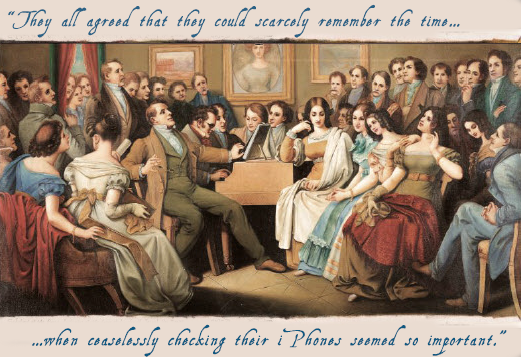
Lacking what we’d known as modernity, we could do nothing but gather with our friends about the piano…singing by candlelight.

So, it was not a bang, nor a whimper. Instead of the Stone Age, we’d been thrown into the Biedermeier.

Post-apocalyptic Schubertiade
“They all agreed that they could scarcely remember the time when ceaselessly checking their iPhones seemed so important.”