Rules of Time Travel

The idea for Symphony in E (the novel) originated with a set of Rules of Time Travel I concocted one day. The overriding rule was that you couldn’t change past events for famous personalities. I went looking for lesser names and found some artists and musicians who’d died in obscurity leaving behind little more than a masterpiece or two. One story worth writing involved the Limbourg Brothers, that trio of Dutch miniature artists from Nijmegen who left us Les Trés Riches Heures du Duc de Berry—one of the glories of late Medieval painting. Then I found the tragedy of young Hans Rott, the 19th Century Viennese composer who was so ignored and abused, he went mad at age 22. His beautiful Symphony in E — not performed for one hundred years — still sparkles with youthful optimism. In my historical fiction, I connect the story of Hans Rott’s life (1850’s – 1880’s Vienna) with the story of his Symphony’s premiere (1989 Cincinnati) using the following rules of time travel:

1. You Don’t Need A Machine

In H.G. Wells’s The Time Machine, the Time Traveller uses a machine to physically transport himself to another time period. While this method is expedient, it is difficult to control. Compare it to picking a flower using a backhoe—all the subtlety is lost.

Other forms of time travel do exist—you may have even experienced time travel faintly yourself just using your five senses. If hearing a song learned in childhood makes you swoon for a moment, or smelling something rich and exotic reminds you of an ancient spice market, you have experienced time travel in its most rudimentary form. In order to make the leap to advanced time travel, your senses need to be aided by stronger agencies.

2. Importance Of A Talisman

Talismans are physical objects that, when held in the time traveller’s hand, allow observation of or travel to another time period. While talismans can open the portal to time, the fear of inadvertently setting off an episode of time travel simply by touching a talisman is ill-founded. Talismans work only when possessed by parties in both time periods, and when they are coupled with one or more unique abilities on the part of the time travellers involved.

3. Shared Abilities And Transcendental Knowledge

Sharing unusual abilities  and transcendental knowledge such as water divining or déjà vu can help time travellers make the leap. These abilities can be grounded by a strong talisman as they are highly unpredictable. They’re also hard to detect. How would a time traveller know that possession of an ability such as lucid dreaming is a component of time travel? 

4. Strong Psychological Experiences

When two persons are imprinted with a similar psychological experience, a resonance is formed that can serve as a conduit for communication across time and space. Strong psychological experiences are often traumatic, so the time traveller is wise to observe carefully before digging into their own painful memories. This type of time travel is the most unstable although once mastered, it can prove to be the most rewarding.

5. Not All The Rules Of Time Travel Are Yet Known

We work with what we know. Maybe in the future we’ll understand more.

Symphony in E – the book

Hans Rott

Ever since I read Glenn Kurtz’s Practicing: A Musician’s Return to Music, I’ve wanted to write something in-depth about music. I loved his booked even though it felt unfinished to me. And when I scribbled out some notes I called, The Rules for Time Travel, I found I needed to fit my newly devised rules by researching stories about history’s tier-two and three characters.

One such character was Hans Rott, a Viennese composer who wrote a symphony at age 18, went insane, and then—before he could find his place among the pantheon of great classical composers—died of tuberculosis. The score for his symphony would lie forgotten on a library shelf for one hundred years before a Cincinnati-based conductor decided to dust it off and give it a shot.

I’ve read books or seen films in which classical music appears as though the writer had given only a passing thought to research. You’d think all of classical music could be boiled down into a simple choice of whether Eine Kleine Nachtmusik and The Four Seasons. As part of my time travel Hans Rott historical romance, my retelling deep-dives into classical music in a way that musicians and lovers of classical music might recognize themselves.

Overview

When disillusioned art student Angela Bimmel joins a local community orchestra to play the lowly triangle, she finds herself communicating with long-dead Viennese composer, Hans Rott. 

As each rehearsal draws her nearer to the elusive composer, Angela soon learns that her triangle is only part of a conjuring combination that makes time travel possible. In order to fully make the jump so she can speak with Hans, she must discover them all. And like the tragic Hans Rott, finding all of them means digging deeply into what she fears the most.

Symphony in E – the book – is a romp through classical music as each character — whether a second violin player in a community orchestra or the mighty Johannes Brahms — is accompanied by distinct and timeless masterworks from the orchestral repertoire.

Covid-19 — facing the music

Facing the music

Today marks the halfway point in my chemotherapy — a small point of celebration in a world awaiting a second wave of Covid-19. In fact, my diagnosis goes back almost exactly to that same unlucky Friday the 13th in March when Vancouver joined the rest of the world by grinding to a halt.

And while most of us succumbed to binge watching Netflix and online shopping (and a smaller number actually contracted coronavirus or found themselves on the front line of the disease), I played hide n’ seek with the Pandemic while attending the cancer clinic for treatments (and occasional trips to the hospital’s emergency room).

It was also during this time that my mother, who was quarantined in an assisted living residence in Toronto, put herself on end-of-life care (in part so she’d be allowed to receive family during Covid-19). It’s hard to put a carefree spin on cancer, but I tried to assure her saying I had “good news” and “bad news”. The good news was that it’s treatable and I didn’t need to say the bad news given our family propensity for cancer. Despite my attempts to make light, she fretted in her final days. On Easter Morning she passed away. Her last words to me were “I’m sorry” which I took to mean, “I’m sorry I can’t be here for you while you go through cancer.”

During this tumultuous time, I naïvely looked forward to some spare time for music and writing. But that’s been nearly impossible as my health dipped repeatedly below the level that could, for example, allow me to sit at a desk or find the air capacity to puff into my clarinet or tárogató. Even so, I was able to take an online fiction writing course and record some tracks on my penny whistle (ya gotta start where you’re at).

Finding a New Voice for the Tárogató

Voice of the performer

My own journey as a musician has been through many migrations itself, and at times has all but gone extinct. Following my formal music education (University of Toronto, Banff Centre for the Arts, etc.), and a two-year stint with the Prince George Symphony, I became a regular extra freelancing with the Vancouver Symphony. After my near misses auditioning for the elusive orchestra job, I found that I’d basically sculpted myself into the sort of a player who might win an orchestral audition, but little else. In other words, I was left feeling more like a service provider than a performing artist. A long silence followed.

Voice of the tárogató

Then, following a fateful encounter with a certain tárogató, the flame was relit. When a Hungarian cellist-friend in Kelowna called to ask if I’d “learn his tárogató” to as to play it at the Okanagan Hungarian Centre, I didn’t expect to fall in love with the instrument so fast. I soon found a maker in Budapest to build me an instrument I could call my own.

In 2017 when I produced the concert Refuge, I sought to tell the story of the contribution made to Vancouver by the arrival of 200 Hungarian university student and faculty refugees following the failed 1956 Hungarian Revolution. Their contributions notably impacted BC forests practices and their presence is still felt today both at UBC and throughout the province. The concert drew large numbers from the Hungarian community as well as the general public interested in learning about this unusual BC refugee community.

“On behalf of the University of British Columbia, I am writing with warm congratulations on the completion and upcoming performance of Refuge. This legacy is something that UBC is very proud of and one that we cherish and celebrate.”
— Santa J Ono, President and Vice-Chancellor, UBC

Voice of the woodland caribou

There’s a larger community in British Columbia that I believe the tárogató can touch. A while back, I ran into composer Glenn Sutherland at a Vancouver Symphony concert and after various pleasantries, he described his work as a field biologist tasked with finding out why British Columbia’s woodland caribou were making their way onto the endangered species list. It’s so easy to feel helpless when confronted with such environmental catastrophes, but even so, I wondered what I (what we) could do to help let people know of this unfolding disaster.

Then I remembered a comment of Jeffrey Ryan’s at a rehearsal for the tárogató piece he’d written a couple of years before: “There’s something wild about the tárogató…” and I thought perhaps there was something we could do. As the idea of a composition developed, it became less a didactic message about the caribou, and more about giving a voice to the animal itself—as much as possible to tell the story from the perspective of the caribou. Thus was born the longer-range project, Caribou Crossing. But before that, I have decided that I need to develop and extend my own techniques on the tárogató itself, thus the short-range development project—Finding a New Voice for the Tárogató.

Finding that voice

The tárogató’s capabilities have been only lightly documented. When I went searching for a fingering chart, for example, I invariably found something appropriate to a novice player (one fingering per note).

My work on the tárogato showed much richer possibilities with  multiple fingerings that could be used both for colouristic effects and to facilitate difficult passages. Here’s an example from the tárogató I developed while learning Jeffrey Ryan’s challenging Arbutus for tárogató and piano.


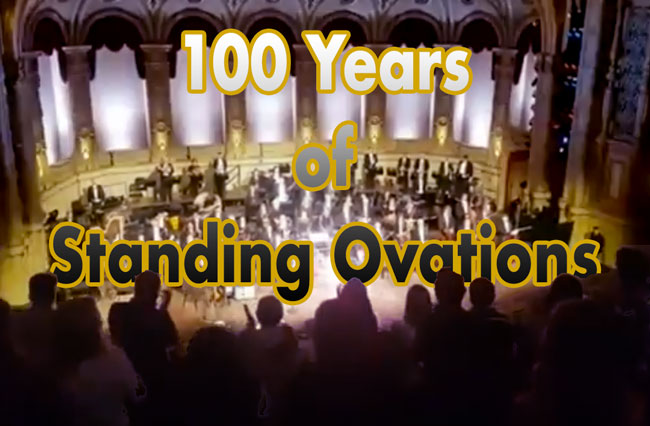
VSO Audience Celebrates 100 Years of Standing Ovations

Vancouver Symphony Orchestra’s 100th Season Concert

A number of years ago, I attended a touring performance of the St. Petersburg Symphony at the Théâtre des Clamps-Élysées in Paris, and what struck me most was the audience. Accustomed as I was here in Vancouver to a steady diet of competent yet unremarkable performances followed by overwhelmingly enthusiastic standing ovations, I was stunned by the restraint of the Parisians. Not that the St. Petersburg Symphony was lack-lustre—anything but! Perched on the edge of my seat, I thought “For sure everyone will go nuts at this!” I’d heard how capably Russian string sections played—the incisive attacks, soaring phrases, and turn-on-dime responsiveness like those sky-blackening murmurations of starlings—so I fully expected all-out pandemonium from the audience when the music stopped. But no. Polite yet sustained applause, and then to the exits.

Which is why when we went to hear the VSO’s 100th anniversary season opener, it was the unbridled enthusiasm of the audience that made the evening so memorable. Here’s what we heard.

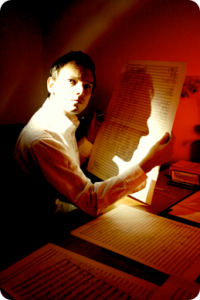
Edward Top (image courtesy Donemus Publishing)

Helix by former VSO resident composer Edward Top set out into more intellectual waters—some sort of references to DNA double helices, I think—but even if you didn’t get the underlying science, the music was full of warmth and cohesion as swirling strands of sound twisted heavenward out of the orchestra.

It wasn’t too long ago that a new commission was greeted with muted horror by audiences preferring a diet that did not stray too far outside the Mozart-to-Rachmaninov spectrum. But applause was hearty and generous. For me, Top’s music holds a lot of subtlety so I thought that if the orchestra had a few more cracks at the score, it would certainly realize Top’s ideas better. World premiers are a risky affair so bravos all ’round.

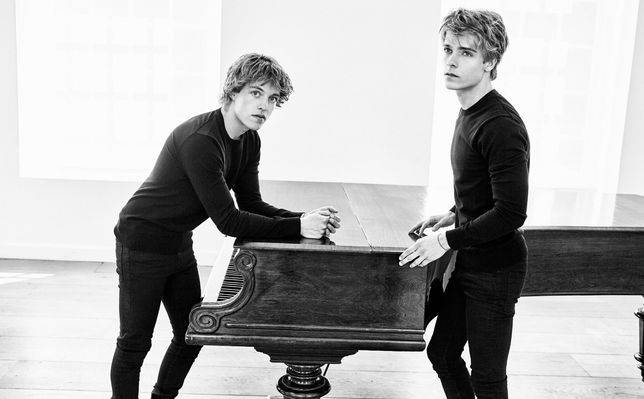
Next up, the concerto. This one provided us with a double Dutch treat: Arthur and Lucas Jussen. These two lads performed Poulenc’s youthful Double Piano Concerto with as much pouty impertinence as Poulenc’s score demanded (which was a lot—and they had a lot). Here, the orchestration sparkles, bright optimistic melodies suddenly sour into petulance, while pilfered memes from Mozart fly by with artless grace. But even before all this could happen, the flaxen-haired boys had sailed onto stage clad in little more than matching skin-tight military, er, jumpsuits, so it was foregone that the audience would swoon.

The Jussen boys  (image courtesy The Georgia Straight)

Lest I give them the looks-over-talent treatment that many attractive female celebrities must contend with, I’ll add that their command of the material was superb and their communication with each other, the conductor, and the orchestra kept everything snappy and focused. Even so, during intermission I overheard one patron remark their performance was “bordering on homoerotic”. That it was, Blanche.

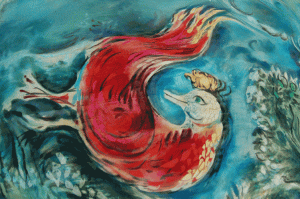
Marc Chagall, model for the curtain in the first act of “The Firebird”.

Stravinsky’s Firebird was the highlight of the programme (not that you’d know from the seats vacated along with the departure of the Dutch boys—I guess they were the real draw). Back in ’65, we were told, the VSO performed the Firebird under the baton of none other that the old bird himself—Igor Stravinsky. Way back then, we were also told, the VSO just performed the Suite from the Firebird (as if that were a simplified version suitable only for school orchestras or something). In truth, there’s a reason why Igor created a concert suite from the full ballet—to be performed on concert stages when no dancers were to be had. I thought perhaps new conductor Otto Tausk might have created a compelling vision of the piece but instead it had a bit of a sitzprobe (cue-to-cue) sound as individual players and sections executed their entrances with precision but without the overarching cohesion needed. But “No matter” concluded the audience as it leapt to its feet in a shameless orgy of applause…

Benjamin Zander, conductor of the Boston Philharmonic, champions the idea of “one-buttock playing”, an approach which I translate to mean playing on the edge—daring to take a risk. In the Firebird, there were indeed moments that shone with unparalleled beauty (by the first violin section) and might  (by the low brass), and Concertmaster Nicholas Wright’s violin solos were sublime. But in this performance, I found that too few of the players sounded like they were ready to risk anything, certainly not a buttock. Perhaps in the next 100 years or so, we can look forward to some of that VSO audience enthusiasm rubbing off more on the players themselves. Bravo audience.